A screen-free game where sound and stress drive interaction
When technology steps back
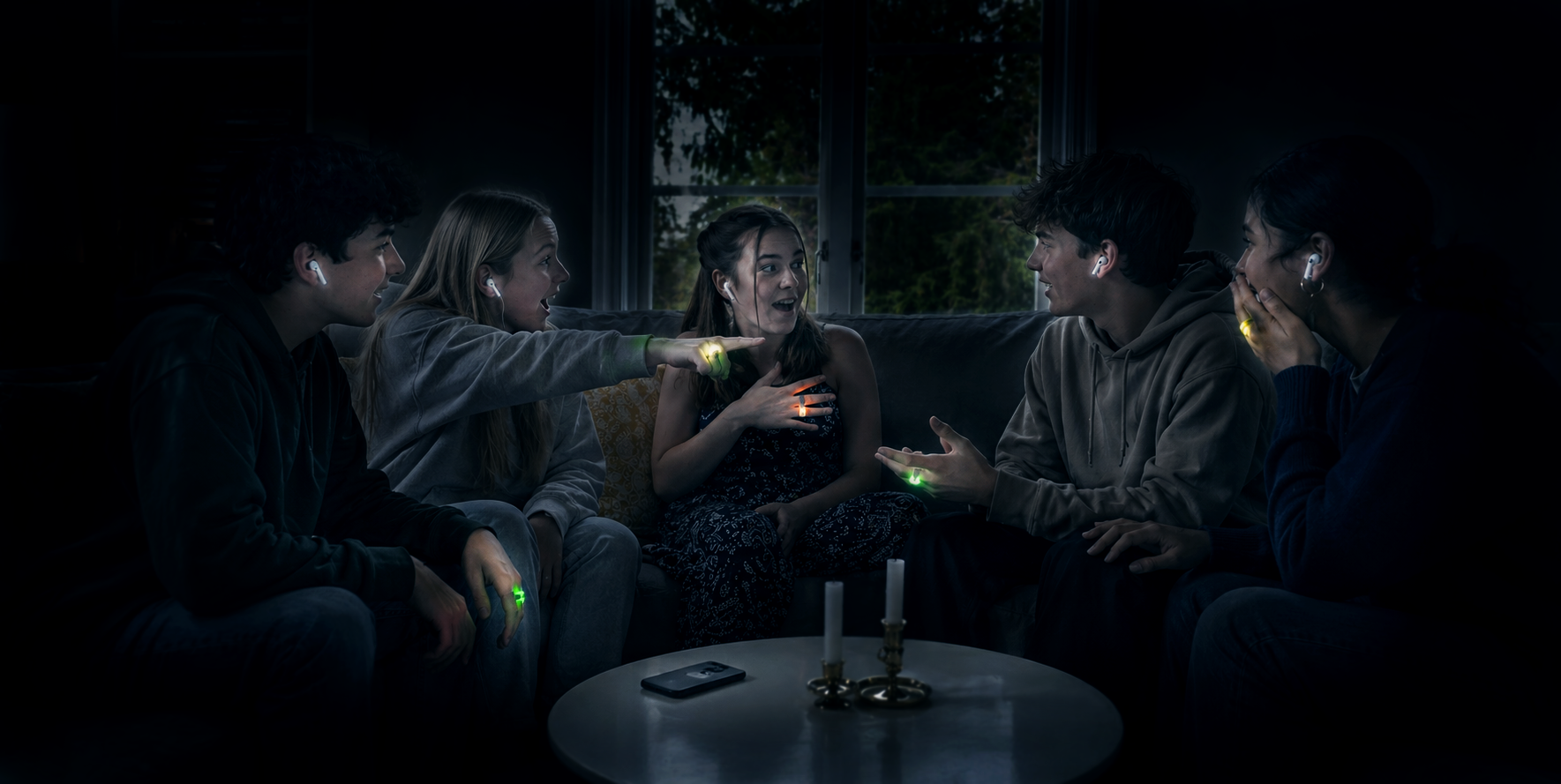
Zombie Stress is a social deduction game where players read each other, make decisions under pressure and react to changing conditions.
The project explores how technology can support physical interaction by moving into the background. The challenge was to design a digital experience where the screen starts the interaction but human behavior drives it.
ROLE
Research · Concept Development · Interaction Design · Prototyping
FOCUS
Screen-free interaction · Social play · Biometric feedback
What the screen cannot replace
The research explored how an increasingly screen-based childhood affects play, social interaction and risk-taking. The focus was to identify which parts of physical experiences could be enhanced through digital technology.
Challenge
Screens reduce the body's signals
When play moves to screens, important parts of interaction disappear: eye contact, movement and reactions.
Insight
Presence requires less interface
Sound can move the interaction away from the screen and back to the players.
Challenge
Children need to practice emotional regulation
Social play helps children understand, manage and adapt to both their own and others’ emotions.
Insight
Biometrics make reactions visible
Biometric feedback creates new ways to notice and interpret emotional reactions.
Challenge
Risk is becoming less present in modern play
As play becomes more controlled, opportunities to test boundaries and handle uncertainty decrease.
Insight
Positive stress can drive development
Safe uncertainty through nervousness, mistakes and unexpected situations becomes part of the experience.
Challenge
Free play needs open frameworks
When every step is guided, there is less room to experiment and solve problems independently.
Insight
The system should create possibilities
The game creates the framework, but the players decide what happens within it.
Exploring invisible interactions
Several prototypes were built and tested across multiple iterations with 2-4 participants each. Two examples are shown here.
Other tests included comparing audio-only instructions and written instructions, and exploring how visualized stress levels (simulated) affect group dynamics and player experience.
The idea was to explore how digital technology could enhance the experience without taking focus away from social presence.
TEST 01
Sound as interface
QUESTION
Can sound carry the experience without a screen?
RESULT
Sound created presence and uncertainty while keeping the focus on the group.
Best experienced with headphones.
TEST 02
Decisions without screens
QUESTION
Can decisions be made without visual guidance?
RESULT
Players could interact without the phone becoming the center of the experience.
An invisible game master
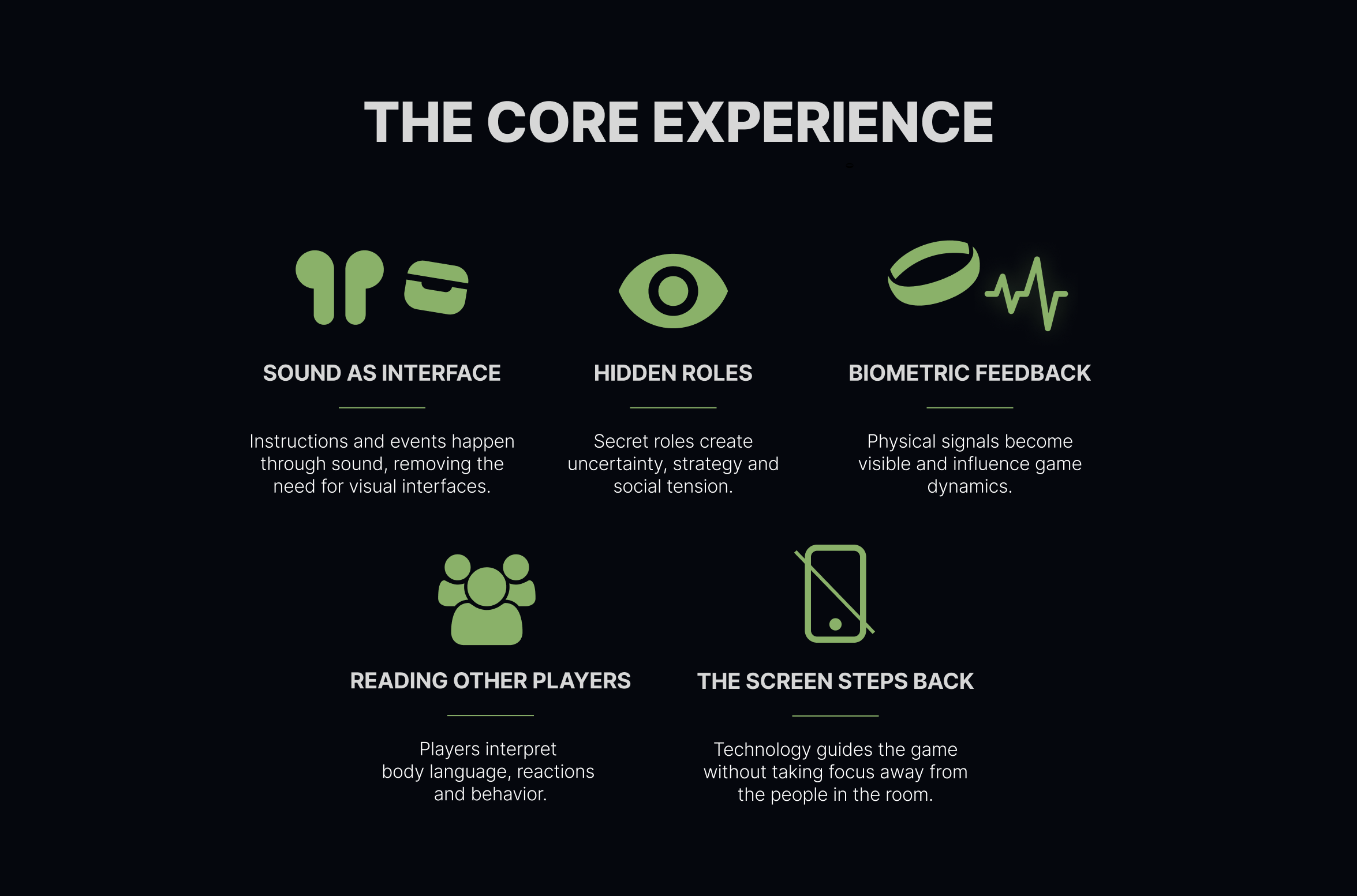
The prototypes led to Zombie Stress: a social deduction game where the phone acts as an invisible game master rather than a traditional interface.
Instructions are given through sound, decisions are made without screens and biometric feedback turns the players’ stress into part of the game dynamics.
The result is a digital experience where technology moves into the background and the players’ behaviors, reactions and body language become the most important signals in the game.
The rules behind the chaos
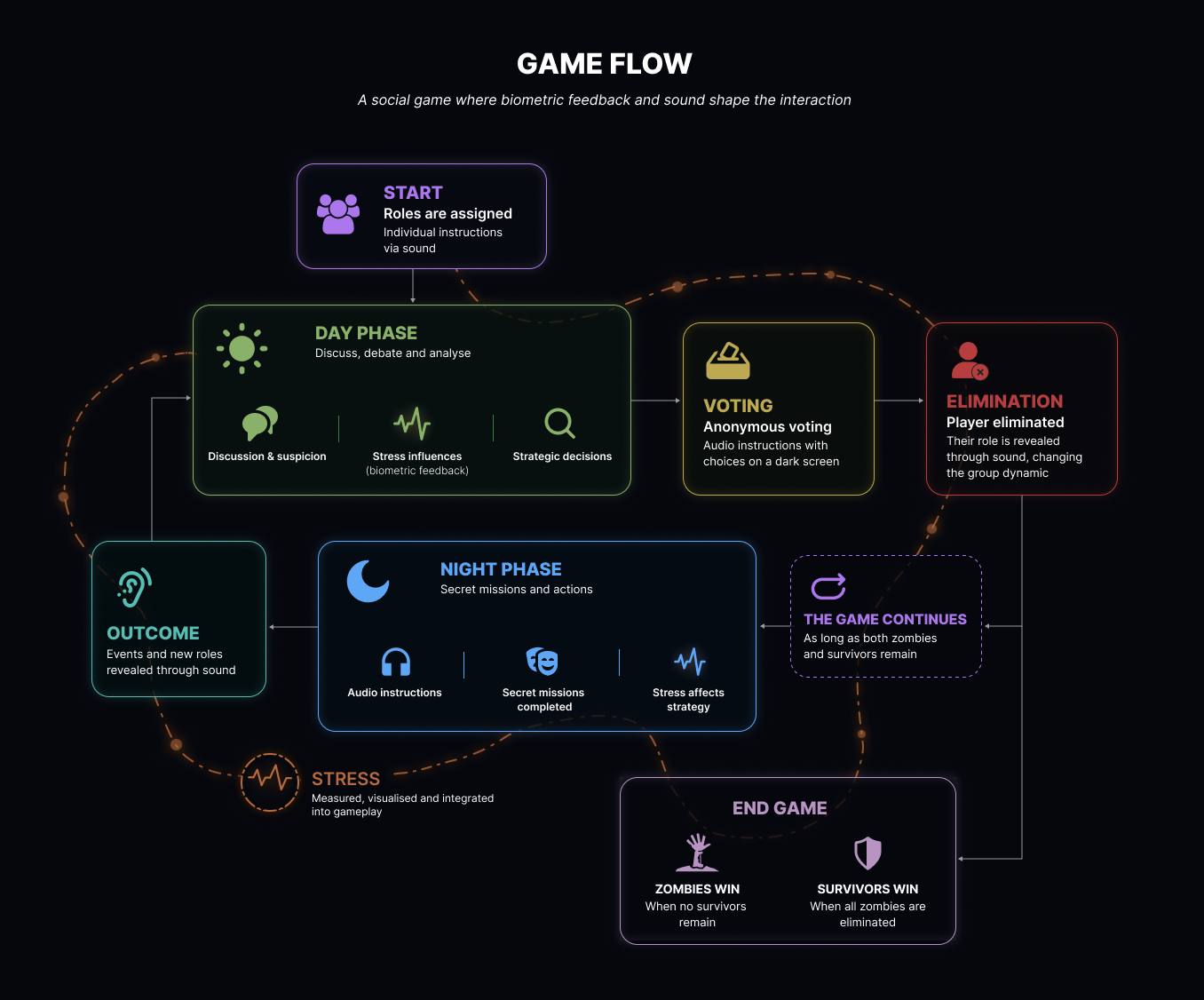
The game alternates between social day phases and secret night phases. Audio instructions and biometric signals change the dynamics between the players.
Designing beyond the screen
The project showed how digital design can be used without creating more screen time. Sometimes technology can instead strengthen what is already happening in the physical space.